
Yes, foreigners can buy property in Dubai in designated freehold areas approved by the government. Investors and expats are legally allowed to purchase, own, rent, or sell real estate in these areas, making Dubai one of the most open property markets in the Middle East.
If you are a first-time foreign buyer, you’ll be glad to know that Dubai offers a streamlined process for property ownership, backed by clear laws and a robust real estate regulatory system. From luxury apartments in Downtown Dubai to waterfront villas in Palm Jumeirah, the emirate gives foreigners full ownership rights in freehold zones. If you’re unsure where to begin, working with any reputed real estate agency in Dubai can help you navigate the options more confidently.
You don’t need residency to buy dubai property. You can also buy through usufruct or leasehold (often up to 99 years). Ownership can make you eligible for residency visas, including a standard property investor visa and the long-term Golden Visa at higher price thresholds.
Key Takeaway
Foreigners can fully own property in Dubai in government-designated freehold areas. The process is straightforward, legally protected, and offers long-term benefits like rental income, capital appreciation, and potential residency visas.
Can I legally buy if I’m not a UAE resident?
Foreign buyers can own freehold property in areas that Dubai designates for non-nationals. Freehold means you own the unit and a share of the land. Outside those zones, you can still secure long-term rights via usufruct or leasehold. There’s no minimum age to own.
What to remember:
- Freehold = full ownership in designated areas.
- Usufruct = the right to use and benefit for a long period.
- Leasehold = a long lease (commonly up to 99 years).
- No residency required to purchase.
Where can foreigners buy property in Dubai?
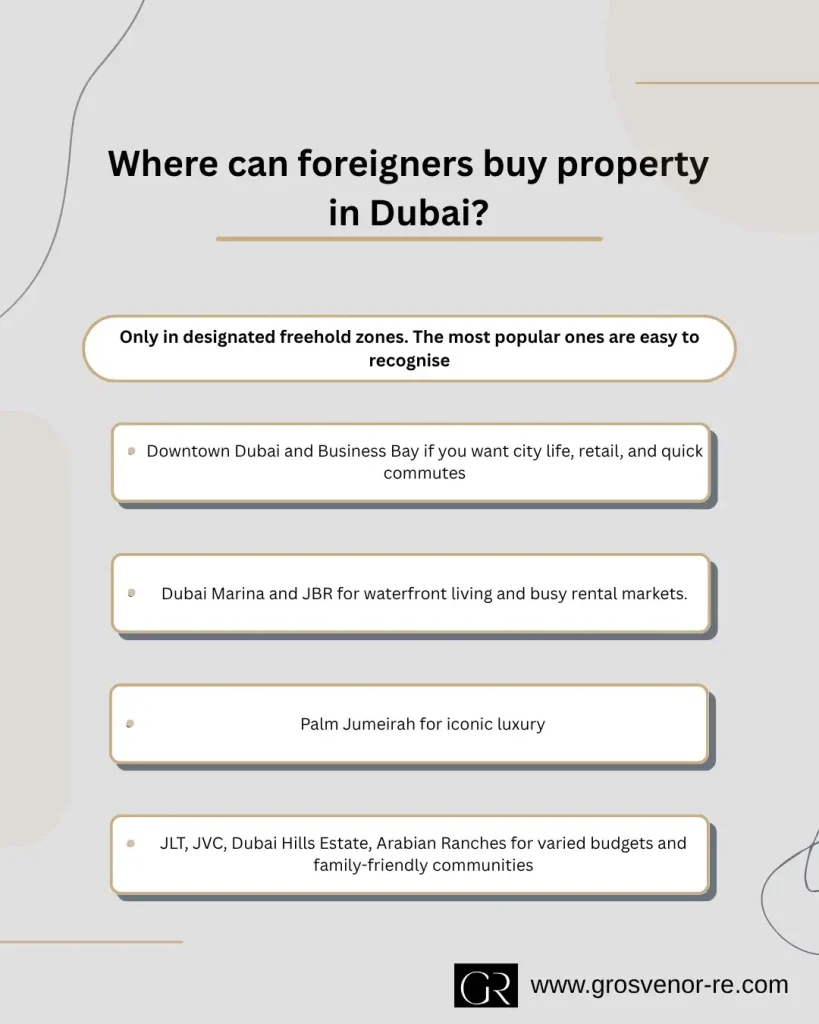
Only in designated freehold zones. The most popular ones are easy to recognise:
- Downtown Dubai and Business Bay if you want city life, retail, and quick commutes.
- Dubai Marina and JBR for waterfront living and busy rental markets.
- Palm Jumeirah for iconic luxury.
- JLT, JVC, Dubai Hills Estate, Arabian Ranches for varied budgets and family-friendly communities.
How much does it cost to buy?
For a typical ready (completed) resale, plan roughly ~6–7% of the price for closing costs. Here’s a practical, plain-English breakdown you can paste into your budget sheet.
| Cost item | Typical amount | Notes |
| Dubai Land Department (DLD) transfer fee | 4% of price | Paid at transfer |
| Trustee/Admin/Title issuance | ~AED 3,000–4,500 | Varies slightly by office |
| Agency commission | ~2% of price (+5% VAT on the commission) | Confirm in your Form B |
| Developer NOC (resale only) | AED 500–5,000 | Clears seller’s dues |
| Mortgage registration (if financed) | 0.25% of loan + AED 290 | Bank also charges a valuation fee |
| Bank valuation (if financed) | ~AED 2,500–3,500 | Depends on lender |
Worked example:
On a AED 1,500,000 apartment with no mortgage, your total closing cost is often ~AED 95k–101k (about 6.3–6.7%). That includes DLD 4%, trustee/title, typical agency commission, and a modest NOC.
Do I get a visa if I buy?
Property ownership doesn’t automatically grant residency. But you can qualify for property-linked visas if you meet the value thresholds and conditions at the time you apply.
- Property Investor Visa (2–3 years): available from a set minimum property value (often the entry route for first-time buyers).
- Golden Visa (long-term, usually 10 years): available at a higher property value. Some mortgaged or off-plan cases can qualify if they meet the rules.
- Family sponsorship: certain property visas allow you to sponsor immediate family members.
Simple tip: if a visa is part of your plan, decide your target visa first, then pick a budget and property that clearly meet that tier. It avoids last-minute reshuffles.
How does the purchase work in Dubai – step by step?
Let’s keep it human and practical. Here’s what it looks like in real life.
1) Clarify your goal
Are you buying to live or to invest? If it’s lifestyle, focus on commute, schools, amenities, and community feel. If it’s yield, study net returns (after service charges and vacancy) rather than glossy photos.
2) Set your budget (cash vs mortgage)
Cash is fastest. Mortgages for non-residents are common, but they take more prep. Either way, keep a buffer for closing costs and furnishing.
3) Shortlist areas and buildings
Create a two-by-two: two areas you like × three buildings in each. On each building, note: age, finishing, elevators, parking, service charges, and rental demand. Visit at different times of day.
4) Work with a RERA-certified broker
A good buyer’s agent saves time, flags red flags, and keeps forms clean as Grosvenor Real Estate Dubai does for you. You’ll sign Form B (explains representation and fees).
5) Make an offer and sign the contract
For resales, you’ll sign Form F (MoU). It sets price, deposit (often 10%), and completion timeline. For off-plan, you sign the Sale and Purchase Agreement (SPA) with the developer.
6) Get the developer NOC (resale)
This confirms the seller has cleared service charges and there are no outstanding issues. It’s a routine step, but it’s important.
7) Transfer day at a DLD Trustee Office
You and the seller (or a Power of Attorney) meet, pay the transfer fees, hand over manager’s cheques, and complete the paperwork. The title deed is issued in your name.
8) After transfer
Turn on DEWA, book move-in, and do a snag list if needed. If you plan to rent: register Ejari for long-term leases or apply for a Holiday Home permit if your building allows short-term stays.
Can foreigners get a mortgage in Dubai?
Yes. It’s common, even if you live abroad. The key difference is the loan-to-value (LTV) banks will offer.
Foreigners can get a mortgage in Dubai, even if they live abroad. Many buyers work with mortgage brokers to compare banks, understand eligibility rules, and secure better rates, especially if they are non-residents.
| Borrower profile | Typical LTV range | What that means |
| UAE resident (expat) | Up to ~80% on a first home (caps apply) | Lower down payment, more leverage |
| Non-resident (living abroad) | ~50–60% | Higher down payment; prep documents early |
What lenders look for: stable income, bank statements, credit history, property valuation, and sometimes an in-person signing or a Power of Attorney. Ask for an Approval in Principle before you start viewing. It clarifies your budget and speeds up offers.
Can I rent out my property (short-term or long-term)?
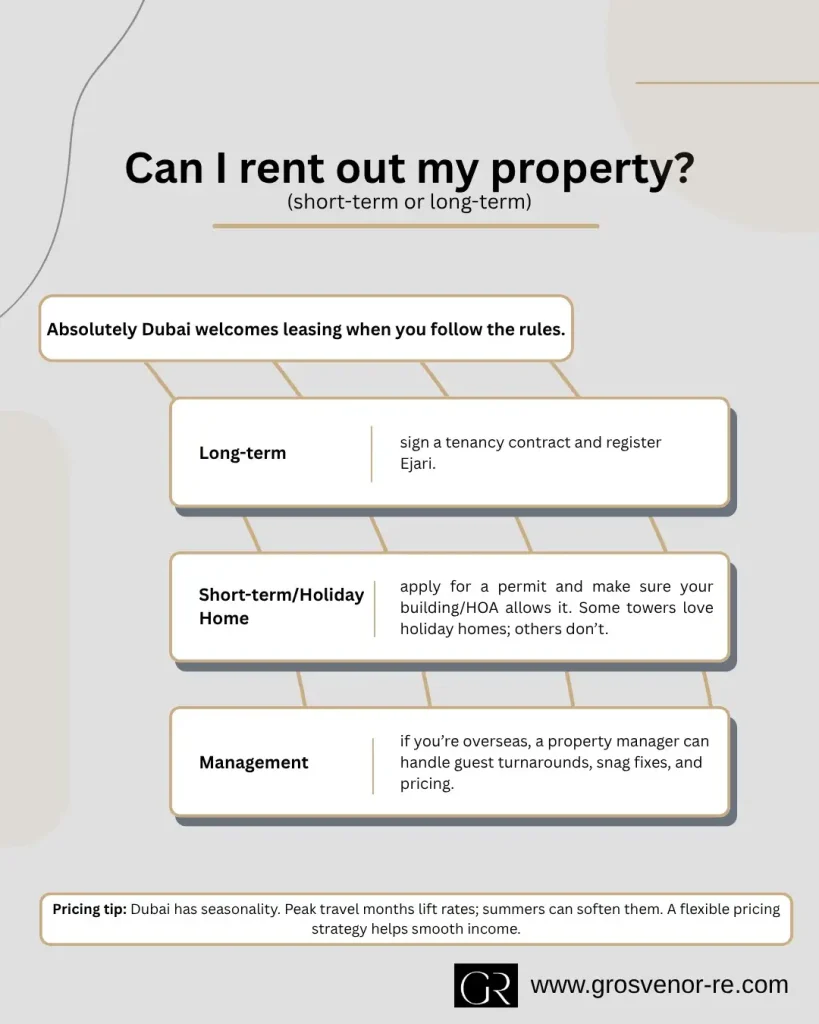
Absolutely Dubai welcomes leasing when you follow the rules.
- Long-term: sign a tenancy contract and register Ejari.
- Short-term/Holiday Home: apply for a permit and make sure your building/HOA allows it. Some towers love holiday homes; others don’t.
- Management: if you’re overseas, a property manager can handle guest turnarounds, snag fixes, and pricing.
Pricing tip: Dubai has seasonality. Peak travel months lift rates; summers can soften them. A flexible pricing strategy helps smooth income.
What ongoing costs should I plan for buying property in Dubai?
This is where smart investors stand out. Two similar apartments can have very different service charges, which change your net yield.
- Service charges: billed per sq ft per year. Amenities, age, and tower quality push this number up or down.
- Utilities: DEWA for electricity and water; internet; and sometimes district cooling.
- Insurance: building cover is often handled by the owners’ association; consider contents or landlord insurance for your unit.
- If renting: property management costs, Ejari, and routine maintenance.
Simple formula:
Net yield ≈ (Annual rent − service charges − management − expected vacancy − maintenance) ÷ purchase price.
What taxes apply to foreigners when buying property in Dubai?
Dubai keeps this straightforward for residential property held personally.
- No annual property tax on residential units.
- One-time transfer fee (that 4%) when you buy.
- VAT: most resale residential units are exempt; the first supply of a new residence is generally zero-rated; commercial space usually carries VAT.
- Company vs personal: individuals holding property for passive income typically sit outside corporate tax. A company that trades property is taxed on profits.
If you plan a large portfolio or short-term letting as a business, it’s wise to get a quick structuring chat with an adviser.
Is it worth buying property in Dubai in 2025?
If you want tax efficiency, global connectivity, modern infrastructure, and deep tenant demand, Dubai continues to stand out. Many buyers target ~6–8% gross on apartments in good communities. Your net depends on service charges, vacancy, and whether you finance the purchase. If you buy for lifestyle, the equation is simpler: choose the community that fits your everyday life and budget for the long run.
Tell us your budget, preferred areas, and whether you want lifestyle or yield. Grosvenor Real Estate Dubai will build a shortlist, share service-charge data, and guide you through MoU → NOC → transfer with zero stress. If you’re planning to buy property in Dubai, our team will walk you through every step from choosing the right area to completing the transfer smoothly. Book a consultation to get started.
Conclusion:
Yes, you can buy property in Dubai as a foreigner. Choose a freehold area, plan ~6–7% for closing, and check service charges before you sign. Mortgages are available to non-residents, and ownership can open doors to visas at set thresholds. Keep the steps simple, use a RERA-certified broker, and you’ll go from interest to keys-in-hand smoothly.